Monday, July 28, 2014

2015 Hyundai Sonata: One amazing car, terrific value and astonishing design

image
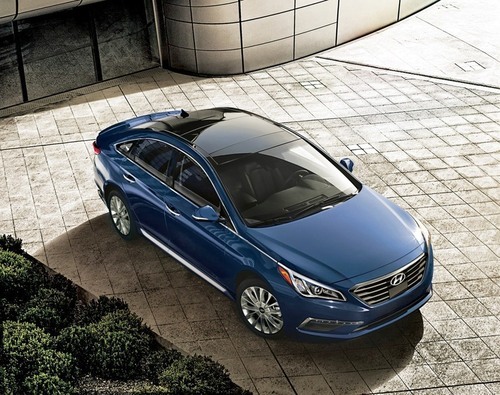
MEMPHIS, July 26, 2014 — The Sonata has been one smash hit for the Korean automaker. Hyundai recently announced its seventh generation model of this amazing car. Hyundai Sonata was nothing short of a smash hit in the midsize sedan segment, and so was the one before that and before that and before that.
The new generation trades some of the swoopy curves of the previous version for more conservative lines that take the styling to a much higher level. The outgoing generation of the Hyundai Sonata was a bold move that has paid off big time for the automaker, drawing attention to Hyundai with its daring yet practical design, strong yet efficient engines, and good value all around. The new model is a little bigger than before, and rear passengers benefit from a little more hip and legroom. The chassis has also been overhauled to improve both the Sonata’s handling capabilities and its ride quality.
imageThe new Sonata is 1.4 inches longer and 1.2 inches wider than its predecessor, and rides on a 0.4-inch longer wheelbase. Its new body boasts torsional and bending stiffness increases of 41 & 35% according to the folks at Hyundai, and 52% of its steel is of the advanced high-strength variety. Hyundai says the new Sonata will be safer than ever, too, thanks to the stiffer body as well as new driver knee airbags.

And as if this was not enough to make this car a great value and amazing vehicle, the actual design isn’t the only attribute that stands out. The number of features available is impressive, such as available heated and cooled front seats, heated rear seats, a panoramic sunroof and segment-exclusive rear sunshades. You can upgrade the multimedia head unit between two touch-screen audio setups, with the ultimate option featuring a seven-inch touch-screen and the Hyundai BlueLink telematics system. Using this system Sirius XM subscribers can even record live radio to listen again later. Hyundai also promises Apple CarPlay support and Android Auto compatibility in the near future that will allow users to let their smartphones to further enhance their infotainment experience with brought in apps, locations and improved integration between the phone and the car. An impressive compliment of safety technologies can also be special ordered, including Blind Spot Detection with Rear Cross-Traffic Alert and Lane Change Assist, Lane Departure Warning and Forward Collision Warning.

Hyundai also revised the engines, but instead of upping the horsepower and torque in the 2.4-liter and two-liter turbo models Hyundai decreased output. The 2.4-liter model makes five horsepower less, while the turbo model loses almost 30 hp. That decrease is supposed to make peak power more easily accessible. While the engines don’t feel particularly powerful, they both offer smooth acceleration and are both relatively quiet.
We were very impressed to learn the fuel economy in this new Sonata hovers around 25 mpg in the city and 37 on the highway for the 2.4-liter engine and 23 mpg in the city and 32 on the highway for the turbo. For the truly mileage-minded, another option for the Sonata is a turbocharged 1.6-liter Eco engine with 177 horsepower and 195 horsepower that gets 28 mpg in the city and 38 mpg on the highway.
Prices for the Sonata start at $21,125 for the base model with an automatic transmission, while different engine and equipment packages can set you back to around $33,495., excluding an $810 in destination fees automatically tacked on to every car.
We have had numerous family members and friends get into a Sonata over the years and thus far we have not had one contact us with any sort of complaint or grievance. They have all been great cars, especially from the fourth generation on up… a terrific car despite some shortcomings, but this new 2015 Sonata takes the cake in so many different areas, which puts it in the lead against so many challenging competitors in one of the toughest segments in the car business today.

Tuesday, July 22, 2014

Hyundai Accessory Store's Deal of the Week

Add to Cart - Deal of the Week 07/22 - 07/29
Save 16% on all orders

SAVE 16% ON ALL ORDERS - USE COUPON CODE "DOTW0722"

Offer expires July 29, 2014 11:59pm (EDT). Please call 1-800-852-4216 for complete details.

Gary Rome Hyundai
1000, Main Street
Holyoke, MA 01040

Hyundai's Hope on Wheels Shows How Great an Automaker Can Be

image
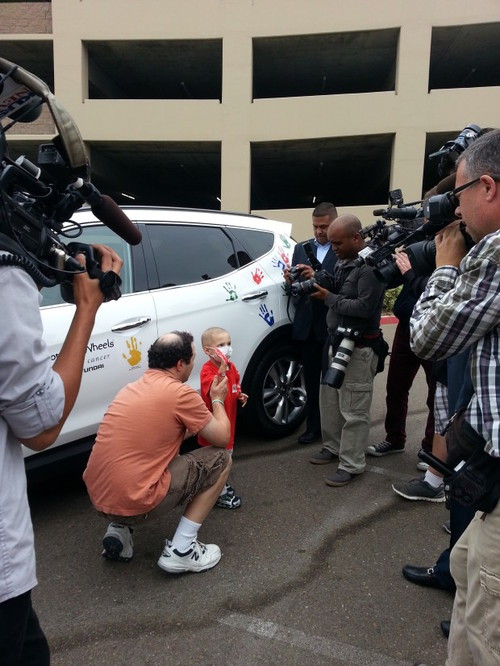
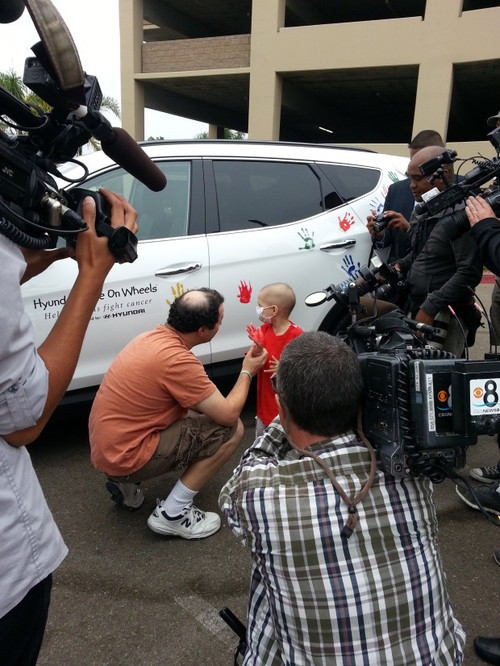
Hyundai Hope on Wheels 1Micah and his father leaving his hand print on Hyundai’s Hope on Wheels Santa Fe. Rady Children’s Hospital in San Diego, CA
Micah and his father leaving his hand print on Hyundai’s Hope on Wheels Santa Fe at Rady Children’s Hospital in San Diego, CA
Hyundai’s Hope on Wheels donates funds for childhood cancer research, raises awareness of pediatric cancer and gives hope to those who suffer. Hyundai Motor America and its more than 820 U.S dealers, along with customer support, are committing serious funds to help fight childhood cancer. Hyundai’s Hope on Wheels is a 501(c)(3) nonprofit organization.
Although many automakers sponsor charities, Hyundai is remarkably hands on with Hyundai’s Hope on Wheels.
Micah is a scrappy little guy who’s been fighting cancer since he was a baby. He’s smart, curious and precocious while exhibiting that one special trait of what a three-year-old typically should be – happiness. To meet him in person, you would be hard pressed to see evidence of his illness. Micah’s cancer has gone into remission several times, only to come back.
His parents Kate and Jeff contend with this reality with an internal fortitude that actually gives others strength. As a parent of young children, I am in awe of people like Micah’s parents. I could never imagine what they go through on this emotional roller-coaster, the tremendous strength it must take. I find it nearly inconceivable.
“The mission of Hope on Wheels is to raise awareness for childhood cancer, donate life-saving research funds and celebrate the lives of children affected by this disease. The program provides grants to eligible institutions nationwide
Hyundai Hope on Wheels 2e pursuing innovative pediatric cancer research. These grants are designed to develop new treatments and ultimately a cure. We are committed to providing the much-needed support in the fight against childhood cancer. Hope on Wheels’ ultimate goal is to fund the needed research that will bring about the day when no child ever has to hear the words, “You have cancer.”” – - Hyundai Hope on Wheels
Micah leaves his hand print (with the help of his father Jeff) during the Rady Children’s Hospital’s acceptance of the Hyundai’s Hope on Wheels award ceremony
image
Micah is my brother-in-law’s nephew and I’ve had the good fortune to see him grow and thrive, despite the cancer. Thanks to programs like Hyundai’s Hope on Wheels, children and their families who suffer from childhood cancer have a powerful ally.
“We created a new grant category called the Hyundai Scholar Hope Grant, a competitively selected two-year $250,000 award. Recipients of the Hope Grant are selected from the nation’s best and brightest institutions.” – - Hyundai’s Hope on Wheels
Recently, Micah’s hospital, Rady Children’s Hospital, received a $75,000 grant award from Hyundai’s Hope on Wheels. “Dr. Udaka, a fellow at the Peckham Center for Cancer and Blood Disorders, received a 2014 Hyundai Young Investigator Clinical Award to fund her work on brain tumors in children. She is one of 13 recipients of this award, which helps principal investigators pursue research and implement clinical programs aimed at improving the lives of children battling pediatric cancer.”
“Hyundai is a brand that not only builds great cars, but is committed to doing good things that serve society’s needs,” said Dave Zuchowski, President and CEO of Hyundai Motor America. “Pediatric cancer is an issue that affects far too many children. Together with our dealers, we joined this fight in 1998. We are committed to ending this disease by funding life-saving research. Through Hope On Wheels, we look forward to a world in which no child will have to face this terrible disease.” – - rchsd.orgHyundai Hope on Wheels 3
Micah and Jeff admire their handy work during the Hyundai’s Hope on Wheels ceremony at Rady’s Children’s Hospital in San Diego, CA.
The Fast Lane Car team wishes to extend a special thank you to Hyundai Motor America and its more than 820 U.S dealers for implementing this incredibly important program. Hyundai customers should know what a kind and generous organization their automaker represent. With programs like Hyundai’s Hope on Wheels, children like Micah and their
image
families have a great tool in the fight of pediatric cancer.
Author Nathan Adlen, Hyundai, Opinion and Editorial

Thursday, July 17, 2014

GARY ROME HYUNDAI's EXPRESS SERVICE


Gary Rome Hyundai's Express Service makes maintaining your Hyundai easy.

There's no need for an appointment just drive in. Our dedicated express consultants will check you in and make sure that your car gets the care it needs - Right away.

While you wait, make yourself at home in our cozy lounge area with free WIFI, and a coffee bar. Two certified technicians will tend to your vehicle simultaneously. We will change your oil and filter, rotate your tires, top off your fluids, and do a complimentary multi-point inspection to ensure your Hyundai is safe and reliable. As a bonus we vacuum and wash your car!

With Gary Rome Hyundai you know you're getting the best care for your car! With our competitive prices, express service, and convenient hours;

Monday -Thursday 7:30am-8pm
Friday 7:30am -6pm
Saturday 8am -4pm

Come in today and see how Gary Rome Hyundai's Express Service will keep you going with less waiting so you can... Get in, Get Out, and Get back to your life.

Gary Rome Hyundai, the BEST DOGGONE place, to buy a car!

Located at:
1000 Main Street
Holyoke, MA 01040
888-637-4279

Friday, July 11, 2014

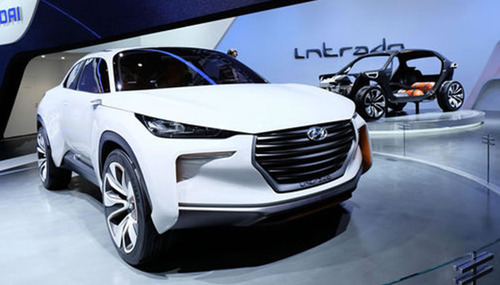
Hyundai Intrado F-Cell – A Hydrogen Car

image
July 11, 2014 by gary rome hyundai Leave a comment
RESAVED FUEL CEL from fireworks
July 09, 2014
Lately, there has been quite a stir in the global automotive industry owing to the use of more environmental-friendly resources in order to conserve maximum energy for the upcoming future. Each auto maker is tending towards employing a new type of technology, which caters to both aesthetics and functionality of a vehicle. While some auto giants have geared up to transform their cars into an all-inclusive hybrid, others have made a more pragmatic approach and opted for Hydrogen Fuel-Cells. The latest name in this expansive list is of the South-Korean auto giant, Hyundai who has planned to convert its next-generation car in the same specification. The upcoming Hyundai Intrado model of the company will be transformed into a green car for better fuel dynamics and driveability.
The company had unveiled this concept recently on a worldwide stage claiming it to be the glimpse of Hyundai cars of the future. The Hyundai Intrado F-cell cars will be forming the bases of the futuristic designs and innovation of the company. Interestingly, Intrado is among the first-ever Hyundai car models to be incorporate with such kind of powertrain. Based entirely on the auto maker’s iconic Fluidic Sculpture Design Philosophy, this model will be the upcoming Sports Utility Vehicle (SUV) of the company. The company officials claim that this green car has been a result of the consumer’s demand for creating a more interactive and easily functional vehicle. The Hyundai Intrado F-cell cars will be offering a revolutionary driving experience to the passengers in the most cost-effective and environmental-friendly manner possible.
The concept car has been created with precise engineering and latest techniques to suit the taste of modern day buyers. This SUV is one of those Hyundai car models, which have been created to keep the entire weight of the vehicle proportional and downwards. The concept car’s chassis has been designed using reinforced carbon fibre structure and light-weight steel has been wrapped over it to provide rigidity. This green car is equipped with a heavy 36-kWh lithium-ion battery pack, which will power the new generation hydrogen fuel-cells to put the vehicle in motion. Moreover, the concept SUV will be able to reach 0-100 kmph within 12.5 seconds and onto a top speed of over 200 kmph.
For refuelling, the car can be stopped at any nearby hydrogen fuel station and can be filled within minutes. In full tank, this SUV concept car is expected to cover a range of over 600 km before getting fully drained.
The Hyundai Intrado F-cell cars are expected to be sent into production soon and will be launched in the upcoming time. If launched in the domestic auto market, this model will certainly be among the most amazing Hyundai cars in India. The company has not unveiled any further plans but reports suggest that this SUV concept will be one of the expensive Hyundai car models in the world. Initially, the cost of manufacturing these hydrogen cars will be hefty but after proper architecture has been laid, the amount will certainly get reduced steeply.
Author: by Eliza Lobo in Greens.
source

Monday, July 07, 2014

New Hyundai Genesis can outfox speed cameras


Getty Images: 2015 Hyundai Genesis

Even the best drivers occasionally press their foot a little too hard on the gas pedal.
But the engineers at Hyundai have come up with a way to save speeders from their own bad habits. The automaker is showing off a new system that not only alerts the driver to hidden speed cameras, but will automatically slow the vehicle down to avoid a ticket.
"It knows there is a speed camera there," spokesman Guido Schenken told reporters during a session marking the Korean launch of the newly redesigned 2015 Hyundai Genesis sedan. "It knows where the speed camera is and it will adopt the correct speed."
The system relies on some basic technology. Its onboard navigation system has a database showing where speed cameras are known to operate, and that information is linked to the sedan's auto-brake system. Drivers are given an audible alert about a half-mile before they approach the camera. If the motorist doesn't slow to the speed limit, the automatic braking system kicks in, gradually slowing the vehicle. 
The speed camera system is the first offered by any automaker and is part of a broader suite of electronic safety, comfort and convenience features on the new Genesis sedan, which was designed to compete against such established luxury competitors as the BMW 5 Series and Mercedes-Benz E-Class. 
For now, the speed camera detection system will only be offered in South Korea. But questions surrounding the legality of the technology are likely to arise if it makes its way over to the U.S. 
Several states, Canada and a number of other countries ban the use of radar detectors. But the Hyundai system relies on a database of known locations, rather than a detector system. That difference means, however, that the technology would not work against cops scanning speed from radar detectors on the side of the road. 
For American motorists who want to avoid speeding tickets without slowing down, there are a few options. Where legal, some radar detectors now have access to speed camera databases, as do a number of the portable navigation systems sold by Garmin. 
There also are speed camera apps for smartphones, such as CamSam, which claim to offer continuously updated databases. Like the Garmin navigation units, they provide warnings ahead of a camera, but unlike the Hyundai system, it's up to a driver to respond in time.
CNBC.com

Thursday, July 03, 2014

2015 Hyundai Genesis redesign rivals luxury sedans

Hyundai broke into the U.S. market in the mid-'80s by selling a tiny $4,999 Excel to compete against an even teenier $3,990 Yugo, both of which were promoted as low-cost new-car alternatives to used cars, and both sharing another distinction: Popular Mechanics said the economy cars "deserved to die" and they did.
For 2015 Hyundai brings out the second generation of its midsize sedan appropriately named Genesis. It boasts the sophisticated technology to compete with any $50,000 luxury car rival and Hyundai is hoping for a repeat of the North American Car of the Year distinction bestowed by the nation’s automotive journalists when the Genesis was introduced in 2009. 

We tested the new 2015 Genesis with a V-8 that starts at $51,500. It has undergone a major redesign called Fluidic Sculpture, which is mystery speak that means it has curves and creases and a glossy exterior that gives it an upscale luxury appearance. 

The availability of all wheel drive for snow-belt security and dry road agility overcomes its predecessor’s shortcoming of rear wheel drive only. The 3.8-liter V-6 version offers either rear ($38,000) or AWD ($40,500), the 5-liter V-8 version offers RWD only. Hyundai says about 80 percent who purchase AWD in a luxury car opt for a V-6 so the V-6 got AWD first, the V-8 in the near future. Hyundai estimates AWD could boost Genesis sales by 20 percent.  

Both V-6/V-8 are teamed with 8-speed automatic transmissions with paddle shifters for manual shifting. Both offer stop/start technology to save gas at the stop light. However, the V-6 is rated at 18 mpg city/29 mpg highway with RWD, 18/25 with AWD, the V-8 at 15/23. A 30 mpg highway rating for the V-6, at least 25 mpg highway for the V-8 should be goals for Hyundai to reach. Perhaps add the gas/electric hybrid technology Hyundai offers in other models like Sonata?

The quick and quiet sedan has plenty of pep off the light and into and out of the passing lane. Ride and handling are smooth and blemish free. Continuous damping suspension controls body motion and roll. You can push the sport suspension button for more agile handling on twisting roads. The cabin is virtually noiseless in keeping with the theme that quiet equals quality, and there’s ample stretch room to wiggle limbs while front leather seats cool or heat the occupants’ tender parts on demand.

The best new feature is automatic emergency braking. If traveling at 5 m.p.h. to 50 m.p.h. and the car ahead suddenly stops, full braking is activated to avoid a collision. If between 50 m.p.h. to 112 m.p.h., there's partial braking to reduce the force of impact with the vehicle ahead. At 112 m.p.h., even with partial braking, chances are good both you and the car will need bodywork.

Also new for 2015 are blind spot and lane departure warnings, a CO2 sensor that automatically pumps fresh air into the cabin to prevent driver drowsiness on long trips, panoramic sunroof over both front and rear seats, manually operated rear side window shades, and Smart Trunk, in which you only need stand by the deck lid with key in pocket and arms full of luggage for a few seconds and the lid will magically pop open without having to kick your foot under the rear bumper to activate the power open sensor like Ford requires in its vehicles. 
Blue Link technology gives Genesis electronic sophistication with voice recognition controls, sending for help in a collision, or using your smart phone to find the car misplaced in the concert parking lot, while the infotainment system delivers any and all types of sound, plus stock quotes, sports scores, weather alerts, movie times, and gas prices---as well as location of the lowest priced station.

The optional remote package (free 3 month trial/$99 annually thereafter) starts the car and adjusts heating/cooling before slipping inside, as well as keep tabs on the teens by automatically texting or emailing Dad if the youth are motoring after curfew--and over the speed limit. The system uses Geo-Fence to program a zone you don't want the car to either enter or exit and send an alert when it does. It sends Dad an electronic alert if the teen headed for the library wanders to the mall, instead. Geo-Fence can also be programmed to alert Mom if Dad stopped at the casino when vowing to take the car for an oil change. The system, however, won't be available until November since Hyundai is upgrading it to allow programming from the car rather than a laptop at home.

One other surprise and delight feature---open either front door at night and puddle lamps under the outside mirrors light the pavement below with the word "Genesis" in big, bright letters.

At $51,500, no need for modesty.
2015 Hyundai Genesis midsize sedan
Engine: 5.0-liter V-8
Transmission: RWD 8-speed automatic with Shiftronic
EPA mileage: 15 city 23 hwy
base price: $51,500
price as tested: $55,700

Source:
July 01, 2014|By Jim Mateja, Special to Tribune Newspapers
Photos from Garyromehyundai.com

Wednesday, June 18, 2014

Hyundai Snares Most Initial Quality Awards in its History

Genesis, Elantra and Accent Ranked Highest in 2014 J.D. Power Initial Quality Study -- Hyundai Highest Ranked Non-Premium Brand

FOUNTAIN VALLEY, Calif., June 18, 2014 -- J.D. Power today presented three Hyundai vehicles -- 2014 Genesis, 2014 Elantra and 2014 Accent -- their highest award for initial quality in their respective segments. Hyundai ranked fourth overall in initial quality, climbing six spots from last year, and was the highest-ranked non-premium brand. In total, Hyundai had six vehicles in the Top Three positions in their segments, including two second place finishes for Santa Fe and Sonata and a third-place finish for Equus. This year's results mark the third time Hyundai has been the highest-ranked non-premium brand in the past 10 years, and the third time it finished among the Top Four brands overall.

The award comes from the J.D. Power 2014 U.S. Initial Quality StudySM (IQS). Now in its 28th consecutive year, IQS is the industry benchmark for new-vehicle quality, measured at 90 days of ownership.

"Receiving IQS awards in multiple vehicle segments acknowledges Hyundai's commitment to quality and customer satisfaction across our entire product lineup, not just our luxury vehicles," said Dave Zuchowski, president and CEO, Hyundai Motor America. "Today's awards are a true reflection of the hard work and dedication of all the Hyundai team members here, in Korea and Montgomery, Alabama."

The IQS serves as the industry benchmark for new-vehicle quality and has proven to be an excellent predictor of long-term reliability, which may significantly impact new-vehicle purchase decisions. The focus of the study is model-level performance and comparison of individual models to similar models in respective segments, which helps manufacturers worldwide to design and produce higher-quality vehicles.

In addition to victories in three vehicle segments, the Hyundai brand substantially reduced problems per 100 vehicles and finished fourth overall, gaining six rank positions compared with 2013. The Hyundai overall score was 94 problems per 100 vehicles, 12 fewer than last year and 22 fewer problems than the industry average which actually deteriorated three problems per 100 compared with 2013. Also, Genesis scored back-to-back segment while Accent, with a mere 65 problems-per-100, was the second highest performing vehicle in the study.

ABOUT THE J.D. POWER AND ASSOCIATES 2014 U.S. INITIAL QUALITY STUDY
The 2014 U.S. Initial Quality Study is based on responses from more than 86,118 purchasers and lessees of new 2014 model-year cars, trucks and multi-activity vehicles surveyed after 90 days of ownership. The study is based on a 233-question battery designed to provide manufacturers with information to facilitate identification of problems and drive product improvement. The study was fielded between February and May 2014. The study is used by manufacturers worldwide to improve quality and by consumers to help them make more informed purchasing decisions. Throughout the years, initial quality has been shown to be a leading indicator of long-term durability, which directly impacts customer loyalty and purchase decisions.

HYUNDAI MOTOR AMERICA
Hyundai Motor America, headquartered in Fountain Valley, Calif., is a subsidiary of Hyundai Motor Co. of Korea. Hyundai vehicles are distributed throughout the United States by Hyundai Motor America and are sold and serviced through more than 820 dealerships nationwide. All Hyundai vehicles sold in the U.S. are covered by the Hyundai Assurance program, which includes the 5-year/60,000-mile fully transferable new vehicle limited warranty, Hyundai's 10-year/100,000-mile powertrain limited warranty and five years of complimentary Roadside Assistance. Hyundai Blue Link Connected Care provides owners of Hyundai models equipped with the Blue Link telematics system with proactive safety and car care services complimentary for one year with enrollment. These services include Automatic Collision Notification, Enhanced Roadside Assistance, Vehicle Diagnostic Alert, Monthly Vehicle Health Report and in-vehicle service scheduling.

Monday, June 02, 2014

Gary Rome Hyundai and Gary Rome Kia Sponsor Aaron Lewis Benefit Concert

Greenfield, MA (May 22, 2014) - It Takes a Community Foundation (ITACF) announced today that Gary Rome Hyundai in Holyoke, MA and Gary Rome Kia in Enfield, CT have signed on as lead sponsors for the 4th Annual Aaron Lewis & Friends concert to benefit ITACF. The benefit will be held at The Pines Theater at Look Park in Florence, MA on Friday, June 27 at 5:30 p.m.


Grammy Award-nominated, multi-platinum singer/songwriter Aaron Lewis founded ITACF with his wife, Vanessa, to provide support for New England's rural communities. The benefit concert is one of the non-profit organization's primary fundraisers.
"Gary Rome Hyundai and Kia's generosity enables as many dollars as possible to go directly to the programs and organizations that are crucial to the quality of life in New England's rural communities. We are grateful that they selected It Takes a Community Foundation for their support," comments Lewis.


Timothy Van Epps, President and CEO of The Sandri Companies and ITACF board member, echoes Lewis' comments, adding "The Rome family have a great tradition of giving back to the community. We are honored that Gary has chosen ITACF as a way to continue that tradition and are joining us to strengthen, enrich and preserve rural New England."


"ITACF is critical to the future of our rural communities, and we want to play a strong role in bringing this important event across the finish line," said Gary Rome, President of Gary Rome Auto Group. "This is about giving back to our community, and making the future brighter for all of our children and families."


Aaron Lewis, Staind, and Smith & Myers of Shinedown will perform at the June 27, 2014 benefit concert. Tickets are general admission, with prices ranging from $59-79 plus Ticketmaster service charges. Tickets can be purchased online at www.ticketmaster.com or by calling (800) 745-3000.


About: It Takes a Community Foundation

It Takes A Community Foundation (ITAC) is a 501(c)(3) nonprofit founded by musician Aaron Lewis and his wife, Vanessa, to support initiatives that improve community life -- particularly the lives of children — within rural New England. The charity works with local leaders and community organizations that have firsthand knowledge of the needs of their communities. By supporting organizations, programs, and initiatives that are the social glue that hold rural areas together, ITAC assists these communities in helping themselves. For more information, please visit www.itacf.org


About: Gary Rome Auto Group

Gary Rome Hyundai, based in Holyoke Massachusetts, and Gary Rome Kia, based in Enfield Connecticut provide Hyundai and Kia sales and service to all of Massachusetts and Connecticut. When you visit our car dealerships, expect the superior customer service that you deserve. Get the new or used car that you have been dreaming of by calling or visiting Gary Rome Hyundai of Holyoke and Gary Rome Kia of Enfield today. For more information, go to www.garyromehyundai.com or www.garyromekia.com.

Friday, December 06, 2013

Hyundai Named Most Reliable Manufacturer in CarMD'S Annual Vehicle Health Index Report

Hyundai beat out every competitor to earn the distinction of "Most Reliable Manufacturer" in the 2013 CarMD® Vehicle Health Index™ Manufacturer & Vehicle Reliability Ranking. Released today, the annual report provides a ranking of manufacturers and vehicles with the lowest combined "check engine" repair incidents and costs. The Index ranks the top 10 manufacturers, top 100 vehicles overall, top vehicles by category and the most common repairs by make. After two consecutive years of finishing second Hyundai overtook Toyota and drove to the top of the list with its low repair frequency.


"The 2013 CarMD Vehicle Health Index Manufacturer and Vehicle Reliability Ranking looked at data that applies to more than 119 million vehicles, so to earn this ranking is no small feat," said Leon C. Chen, CEO, CarMD.com Corporation. "We commend Hyundai for its commitment to quality and to its efforts to minimize vehicle operating costs."


Hyundai's 2013 Index rating was .80 with an average repair cost of $312.67, the lowest Index rating of all parent manufactures studied and the second lowest overall repair cost. This year's Index is based on more than 151,000 specific repairs performed on model year 2003 to 2013 vehicles from Oct. 1, 2012 to Sept. 30, 2013. The Index is determined by the manufacturers whose vehicles had the fewest percentage of CarMD repair incidents combined with the lowest cost per repair, per number of registered vehicles on the road. For more information on CarMD including the complete index, visit http://corp.carmd.com.

"Hyundai strives to provide our customers with a worry-free car ownership experience by offering a lineup of vehicles that deliver on both quality and reliability, backed by the most competitive protection program in the business," said Erwin Raphael, director, Engineering and Quality, Hyundai Motor America. "Earning the first place title in CarMD's Vehicle Health Index Report proves that our recipe for combining high value vehicles with long-term vehicle protection is a success."


In addition to vehicle reliability, Hyundai's Assurance program offers vehicle owners a comprehensive suite of car care and protection services including a 5-year/60,000-mile fully transferable new vehicle limited warranty and a 10-year/100,000 powertrain limited warranty. Additionally, Hyundai's Assurance Connected Care offers Blue Link equipped models with free automatic collision notification, SOS emergency assistance, enhanced roadside assistance, monthly vehicle diagnostics reports and maintenance alerts. These programs under the Hyundai Assurance umbrella provide customers with peace of mind long after they drive off the dealership lot.


About The CarMD Vehicle Health Index


The mission of Irvine, Calif.-based CarMD.com Corporation is to empower consumers and the vehicle market by providing the tools and information needed to make better-educated decisions about their vehicles' health and maintenance. An ISO 9001:2008-certified company, CarMD's premier product is the CarMD® Vehicle Health System™, a consumer system that helps drivers monitor vehicle health and minimize related repair costs. The company has built the largest, most up-to-date database of diagnostic trouble codes; expert fixes and repair costs, which it uses to compile its annual CarMD® Vehicle Health Index™ consumer information resource. It is the only Index to offer a ranking of automotive manufacturers and vehicles with the lowest combined "check engine"-related repair incidents and costs. The data for the 2013 CarMD® Vehicle Health Index™ Manufacturer & Vehicle Reliability Rankings was procured from CarMD's network of thousands of certified automotive technicians and database. For more information, including the complete Index, methodology and archived data, visit http://corp.carmd.com. Drivers can also visit www.carmd.com/Scorecard to see how their vehicle ranks and get a list of common repairs by year, make and model.


HYUNDAI MOTOR AMERICA


Hyundai Motor America, headquartered in Costa Mesa, Calif., is a subsidiary of Hyundai Motor Co. of Korea. Hyundai vehicles are distributed throughout the United States by Hyundai Motor America and are sold and serviced through more than 820 dealerships nationwide. All Hyundai vehicles sold in the U.S. are covered by the Hyundai Assurance program, which includes the 5-year/60,000-mile fully transferable new vehicle limited warranty, Hyundai's 10-year/100,000-mile powertrain limited warranty, and five years of complimentary Roadside Assistance. Hyundai Assurance includes Assurance Connected Care that provides owners of Hyundai models equipped with the Hyundai Blue Link telematics system with proactive safety and car care services, complimentary for three years. These services include Automatic Collision Notification, Enhanced Roadside Assistance, Vehicle Diagnostic Alert, Monthly Vehicle Health Report and in-vehicle service scheduling.

Wednesday, October 09, 2013

Gary Rome Auto Group Partners With Premier Motoring Concepts


Holyoke, MA, October 8, 2013 - - Gary Rome Auto Group has embarked on a lucrative partnership with Premier Motoring Concepts (PMC). The deal allows the auto dealer group to feature PMC products on its accessory store websites while simultaneously providing 120 more product choices for customers.
Premier Motoring Concepts is a Hyundai and Kia accessories distributor which sources Hyundai and Kia parts and accessories from South Koreaand make them available in the United States. Featured products are not sold through Hyundai Motor America or Kia Motor America. PMC’s customer base includes the five largest-volume Hyundai dealers in the U.S., as well as dealers that sell fewer than 50 units a month. The company prides itself on its excellent reputation for outstanding customer service and impeccable attention to detail.
“We are very excited to be offering more product categories for customers to choose from in our Hyundai and Kia Accessory Stores” says Gary Rome, President of Gary Rome Hyundai in Holyoke, MAand Kia in Enfield, CT. “This partnership is possible because we always listen to our customers and find ways to solve their problems. Our relationship with PMC will help us supply products which are otherwise unavailable in the United States.
This press release has been distributed by Gary Rome Auto Group. Gary Rome Hyundai, based in Holyoke Massachusetts, and Gary Rome Kia, based in Enfield Connecticut provide Hyundai and Kia sales and service to all of Massachusetts and Connecticut. When you visit our car dealerships, expect the superior customer service that you deserve. With years of experience and training, the Gary Rome Kia and Hyundai teams are your Connecticut and Massachusetts Hyundai and Kia dealer, and will get you into the car that was built for you. Get the new or used car that you have been dreaming of by calling or visiting Gary Rome Kia of Enfield and Gary Rome Hyundai of Holyoke today. For more information, go to http:// www.garyromekia.com/or http://www.garyromehyundai.com/.


Wednesday, September 11, 2013

Hyundai’s $48,000 Genesis beats competitors’ prices

The recent Pebble Beach Concours d’Elegance in Monterey, Calif., showcased the rarest and most costly autos in the world, from a 1935 Duesenberg to Ferrari race cars.
Also included on the lawn were new concept cars from Lamborghini, Aston Martin and Hyundai. Yes, Hyundai.
The South Korean brand has come from the first shoddy exports to North America in the 1980s to the HCD-14 Genesis concept, an automotive sculpture from the brand’s Irvine, Calif., design studio.
Hyundai has declared that it can line up alongside the world’s most storied brands and not look out of place.
While the Genesis concept car won’t go on sale as shown, it indicates where the company is headed, especially relevant for me, having just spent a week in the current model, a 2013 Genesis 5.0 R-Spec.
The Genesis is Hyundai’s rear-wheel sedan and the best example of the company’s unusual blend of budget and luxury.
The Genesis swims in competitive waters, among luxury sedans like the BMW 5 Series, Audi A6, Jaguar XF and the Lexus GS350. It’s unlikely that even the next generation Genesis will snag away 5 Series drivers who look for superior driving chops and brand recognition.
What the Genesis 5.0 does is beat competitors in value, with all of the major options included in the $48,000 price. It also gets a 10-year/100,000-mile power train warranty.
The all-in sticker is a major change from the practices of German automakers, who are especially prone to charging for every option. It’s also not easy to find a base BMW or Mercedes on sales lots.
While there is a base Genesis sedan with a 333-horsepower V-6 and a price of $35,100, the R-Spec is the model most in keeping with its rivals. It has a 5.0-liter V-8 with an eight- speed transmission, 19-inch wheels and leather seats.
Also included are a power sunroof, lane departure warning system, rain-sensing wipers, adaptive xenon headlamps, a navigation system and backup camera. One of the few options you can add is a $35 iPod cable.
I kept comparing the Hyundai to another car I recently reviewed, the Jaguar XF 2.0, which starts at $47,000. The entry-priced Jag looks great and handles extremely well, besting the Hyundai in both categories. But it has only a 2.0-liter turbocharged four-cylinder engine, with 240 horsepower and 251 pound-feet of torque — underwhelming compared to the Genesis’s V-8, with 429 hp and 376 lb-ft of torque.
With all of its options, many which aped the Genesis, my test XF came to $61,100. Not so cheap at all. It’s easy to see why many consumers would happily look to the less expensive Hyundai.
Of course not all is perfect. Hyundai has been on a design roll recently — but the current Genesis is still using older, stilted design language. The front end (which has no logo on the grill) looks like a reinterpretation of a Mercedes, and the sides are bland.
The HCD-14 concept indicates a new direction. It is long and slinky, with an upright sci-fi nose and short overhangs. It also has a rear-hinged back door, the kind of concept car styling which rarely makes its way into the real car.
The production-ready Genesis will be shown at January’s Detroit auto show as a 2015 model, and a company spokesman says it could go on sale the second quarter of next year.
The interior of the current Genesis lacks a suede headliner and first-grade leather. The navigation system mimics the Mercedes rotary control system, a poor choice. It should be a touch screen. One imagines those issues will be fixed in the next generation.
Hyundai’s drive character has steadily improved, but the R-Spec’s steering is artificially heavy, and the body rolls in corners, with odd shudders on broken pavement. The result is a feeling of wallowing, rather than wafting, down the road.
The thing’s got guts, though. Ford has famously offered its 5.0-liter V-8 on the Mustang over the years, and there’s a bit of muscle car character to this engine. It pushes through traffic with a nice bit of rough sound.
Turn off the traction control and gun it around a corner, and you’d even get a bit of tail swinging action like in a 1970s action film.
Again, my mind turns to the next generation, and the improvements that may come. Will it go the way of Lexus, soft and pliant, or BMW, heady and fast?
The R-Spec’s strengths and weaknesses are clear. It makes an excellent entry into the luxury sedan space for budget-minded buyers.
And when the new generation is released, the current car should go on a fire sale with significant incentives. It could make a very good deal a veritable steal.

Tuesday, July 16, 2013

Korean automaker Hyundai's market share is growing in the U.S., and its vehicles are getting larger as well

The Santa Fe used to be a modest mid-size sport-utility truck and is now a large crossover. It's heavy at 4,098 pounds and long at 193.1 inches. It has a large 3.3-liter V6 engine, and its gas mileage is mediocre at 18 mpg city and 24 highway.


I drove the GLS AWD model, meaning it has all-wheel-drive, which adds some weight and cuts its gas mileage. But AWD does give Santa Fe some of its old sport-SUV functionality. Outwardly the Santa Fe looks like most other large crossovers; not much to distinguish it. In fact, it looks more like a minivan now, but with outward opening rear doors instead of sliding van doors.


The crossover's size means it now has room for a third row seat, which is split, and will fold flat in back to boost cargo capacity that otherwise is moderate. My test unit, a Night Sky Pearl (metallic blue/gray), had no power hatch, which seemed a bit odd at the asking price of $35,180.


The GLS starts at $30,100, but this one added $4,100 for a leather and navigation package that included a premium Dimension sound system, leather seating surfaces, heated second row seats and heated steering wheel, a rearview camera, power passenger's seat and, naturally, the navigation system.


Functionally Santa Fe was on par with other large crossovers and minivans.


That direct-injected V6 cranks out 290 horsepower. You can get it to downshift and get this heavy-feeling crossover rolling by tromping the gas pedal. That will affect your gas mileage. Or you can just accelerate normally, which is plenty smooth with the six-speed automatic, but feels lethargic. Coming off a turn at a stoplight and then trying to accelerate to 35 or 40 feels slow and there is some hesitation.


If you plan to tow, it'll lug 5,000 pounds of trailer.


Likewise, if you want to save as much gas as possible, there is an ECO button on the dash that creates earlier shifts and cuts power overall. I rarely used it, feeling I needed the crossover's full power to get the Santa Fe up to proper cruising speeds.


Ride, though, is a strong point. The 4-wheel independent suspension does a good job of handling our crumbling roads and joints between cement slabs on many city streets. The interior is quiet and well-appointed to keep passengers -- up to seven of them -- comfy.


Handling is van-like, but credit Hyundai with giving you three steering choices: Normal, Comfort and Sport. Sport is the most responsive, but still there is play in the wheel and the steering effort is heavy. Comfort and Normal feel pretty much the same, which is to say more vague, yet still relatively heavy.


Braking is fine and all-wheel-drive is standard on this model, so traction will be solid in winter. Stability and traction control are standard here, too.


Inside, Hyundai has created a luxury look and feel in the GLS, including tan perforated leather seats in the test vehicle, matched with a brown textured dash and tiny bits of fake wood trim on either end of the dash. A matte silver finish is used on the doors and door releases.


For families, the best is probably the interior's quiet comfort and well formed seats, plus the fact that there is that third row. Kids will fit in the third row and moderate sized adults in the second row.


I like that both front seats were power controlled and heated, plus the option package gave the second row riders heated seats, a benefit with leather seats that tend to be pretty icy feeling in winter. The thick leather steering wheel also was heated.


That wheel featured a manual tilt/telescope function and a bunch of radio, phone and trip computer buttons on the hub. The GLS model also had automatic headlights, a big covered bin between the front seats, two 12-volt outlets under the center stack, plus an open bin with USB port.


Overhead is an OnStar type system, plus HomeLink on the rearview mirror. I bumped the navigation aid once just adjusting the mirror.


My only interior complaint is Hyundai's insistence of a little chime tune that plays every time you get in the car and shut the door, and every time you shut off the ignition.


While the test unit was pricey, you should know that you can get the same room and many of these features by going with a lower trim level. The base Sport 2.4 FWD (front wheel drive) starts at just $24,700 and earns a much better 21 mpg city and 29 mpg highway due to using a 190-horse 2.4-liter I4. That's 100 hp less than the tested model, so it might be weak for hauling a lot of kids and cargo.


An AWD Sport lists at $26,450 and is rated 20 mpg city and 26 highway. A mid-level 2.0 model with 264-horse 2.0-liter I4 turbo starts at $27,950 in front-drive model, while a top level Limited with AWD starts at $34,850.


Mark Savage welcomes your questions and comments regarding new vehicles at Savageonwheels@yahoo.com.

Friday, June 21, 2013

Hyundai Genesis Received J.D. Power Highest Initial Quality Segment Ranking

Hyundai Nameplate Improves in J.D. Power Initial Quality Study;
Finishes in the Top 10 Overall


COSTA MESA, Calif., June 19, 2013 – J.D. Power announced today that the Hyundai Genesis received the trophy for the highest initial quality in the midsize premium car segment. The award comes from the J.D. Power 2013 U.S. Initial Quality StudySM (IQS). The Initial Quality Study, now in its 27th year, serves as the industry benchmark for new-vehicle quality measured at 90 days of ownership. According to the study Hyundai Genesis owners reported fewer problems with their vehicles than any premium midsize car.


"Outperforming all of our competitors in the premium midsize car segment is a reflection of the dedication of all Hyundai team members," said Erwin Raphael, director of engineering and quality, Hyundai Motor America. "Awards like this demonstrate we're succeeding in connecting with our customers through an unprecedented combination of premium performance, technology, safety and quality."


In addition to Genesis's victory, the Hyundai brand substantially reduced problems per 100 vehicles and finished tenth overall, gaining eight rank positions. The Hyundai overall score was 106 problems per 100 vehicles, seven problems fewer than the industry average. Accent, Sonata and Azera ranked second in their respective segments. The all-new Santa Fe ranked third in its segment.


ABOUT THE J.D. POWER AND ASSOCIATES 2013 U.S. INITIAL QUALITY STUDY

The 2013 U.S. Initial Quality Study is based on responses from more than 83,000 purchasers and lessees of new 2013 model-year cars, trucks and multi-activity vehicles surveyed after 90 days of ownership. The study is based on a 233-question battery designed to provide manufacturers with information to facilitate identification of problems and drive product improvement. The study was fielded between February and May 2013. The study is used by manufacturers worldwide to improve quality and by consumers to help them make more informed purchasing decisions. Throughout the years, initial quality has been shown to be a leading indicator of long-term durability, which directly impacts customer loyalty and purchase decisions.


HYUNDAI MOTOR AMERICA

Hyundai Motor America, headquartered in Costa Mesa, Calif., is a subsidiary of Hyundai Motor Co. of Korea. Hyundai vehicles are distributed throughout the United States by Hyundai Motor America and are sold and serviced through more than 820 dealerships nationwide. All Hyundai vehicles sold in the U.S. are covered by the Hyundai Assurance program, which includes the 5-year/60,000-mile fully transferable new vehicle limited warranty, Hyundai's 10-year/100,000-mile powertrain limited warranty, and five years of complimentary Roadside Assistance. Hyundai Assurance includes Assurance Connected Care that provides Hyundai owners with proactive safety and car care services made possible by the Hyundai Blue Link telematics platform, complimentary for three years. These services include Automatic Collision Notification, Enhanced Roadside Assistance, Vehicle Diagnostic Alert, Monthly Vehicle Health Report and in-vehicle service scheduling.

Saturday, June 15, 2013

2013 Hyundai Sonata hybrid bulks up with more power

By David Booth
Hyundai has upgraded its Sonata hybridfor 2013 with a more powerful electric motor, a more fuel efficient 2.4-litre Atkinson-cycle four-cylinder engine and a lighter, but more powerful, lithium-ion battery. The result is a better Natural Resources Canada fuel economy rating (5.4 L/100 km in the city and 4.9 L/100 km on the highway) as well as improved real-word fuel economy. Indeed, in the city, the Sonata hybrid consumed about half as much dinosaur juice as the Fusion EcoBoost - 7.0 L/100 km versus 13.6. Its parsimony continued on the highway although, like other hybrids, the size of its advantage dissipated as speeds increased. By 120 km/h, it was consuming just 1.0 L/100 km less than the Sonata Turbo and the Accord V6.
Nonetheless, this and its superior drivability see Hyundai's hybrid much improved. Indeed, though the 2013 is seven horsepower down on the 2012 model, it gains 40 pound-feet of torque, making 2013 hybrid much more responsive.

Read more: source